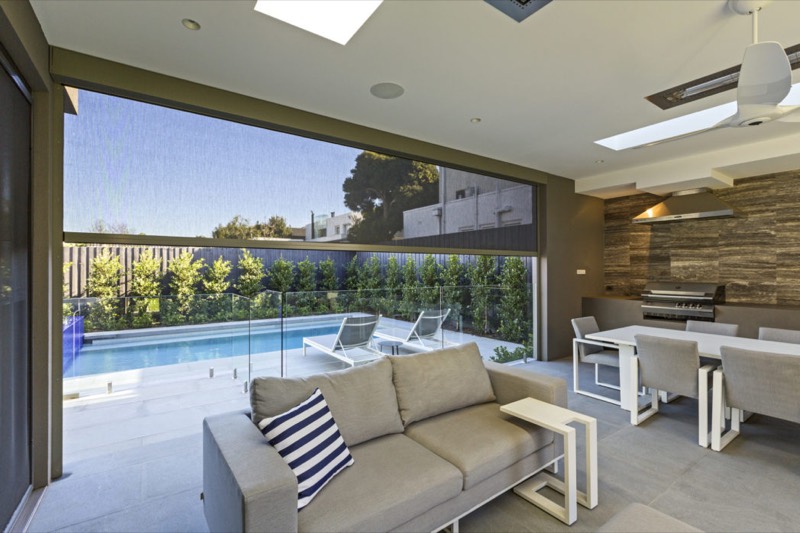
Zipscreen®
Outdoor Blinds
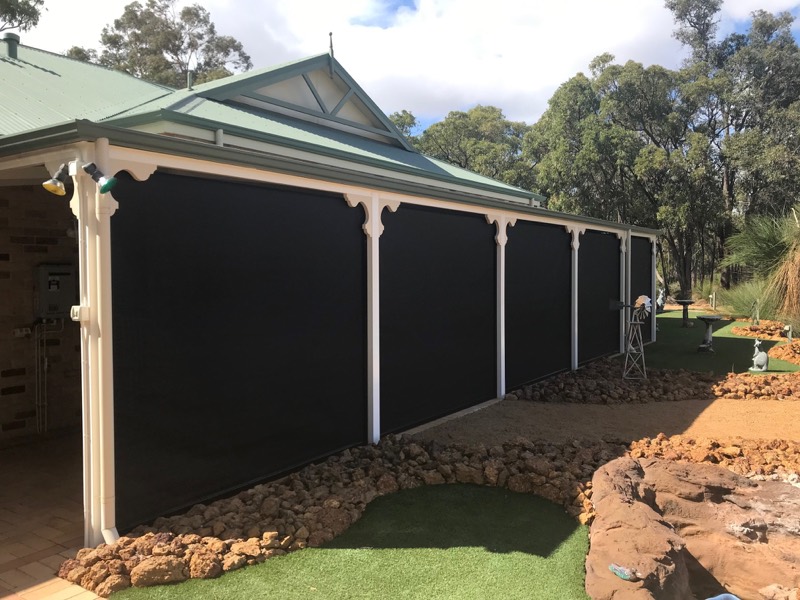
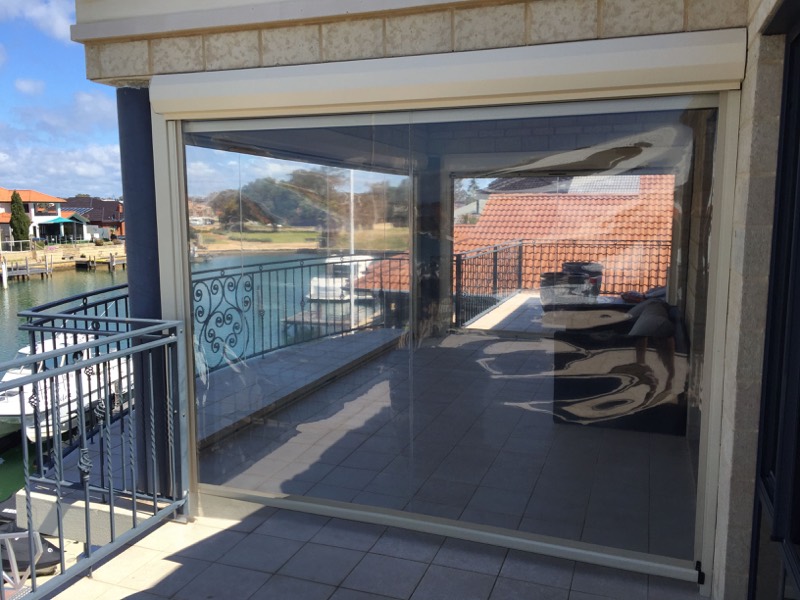
Zipscreen® outdoor blinds are track-guided outdoor blinds whose fabric zips into a channel down each side, sealing the opening on all four edges. Zipscreen spans up to 7 metres on a 120, 160 or 190 millimetre pelmet, and runs on the Automate® platform, so it can be operated by crank, by remote, by phone, by voice, or automatically on a schedule.
Also known as: zip screen blinds, zip blinds, channel guided blinds
*by submitting this free quote request I agree to NSS Privacy Policy
A gap is where the weather gets in.
Most outdoor blinds are held only at the top and bottom, so wind lifts the edges and rain finds its way past. Zipscreen holds the fabric under tension inside side channels, which closes the gap entirely. On a Perth summer afternoon when the sea breeze arrives, that is the difference between an alfresco you can sit in and one you abandon.
- Spans up to 7 m — the widest single blind in the range
- Sealed on all four sides — no gap for wind, rain, dust or insects
- Manual, remote, battery motor or full hub automation — all four on the same system
- Optional wind & sun sensor retracts the blinds on their own
Seven metres, which is past where most of the range stops
This is the specification most people do not see coming. NSS Universal and Ziptrak® both stop at six metres, and Universal is the widest blind Nu Style builds in its own factory. Zipscreen goes to seven. On a wide alfresco that is the difference between one clean opening and two blinds with a post landing in the middle of the view — and the post is the part you cannot un-see once it is in.
Past six metres the range narrows to exactly two: Zipscreen, and wire guide on its remote motor. Both are Zipscreen systems. Which one you end up with is decided by whether the opening has anything solid to fix a side channel to.
You do not have to automate it
Worth knowing, because the Zipscreen name gets attached to the smart-home story so firmly that people assume the whole thing is an all-or-nothing upgrade. It is not. The same sealed track system is built four ways: a crank drive with no power at the opening at all, a wireless remote on a standard motor, a Li-Ion battery motor that charges rather than being wired in, and the full Automate® hub with app, voice and schedules. A pelmet box is optional on all of them. So the decision about how sealed the opening is and the decision about how much technology you want are separate decisions — you can have the first without the second, and add the second later on a different opening.
The cost of an unsealed edge
An outdoor blind that is only fixed top and bottom behaves like a sail. Wind gets behind the fabric, lifts the edge, and the blind slaps against the post all afternoon — which is how fabric wears out early and how fixings work loose. Sealing the fabric into a channel down each side removes the mechanism entirely: there is no loose edge for wind to get under, so the blind stays flat and quiet in conditions that would have an unguided blind flogging.
Why automation actually earns its keep here
Controlling a blind from a phone is a novelty that wears off in a fortnight. What does not wear off is a blind that lowers itself at four o'clock every summer afternoon, before the western sun turns the alfresco into somewhere nobody wants to sit. Because Zipscreen runs on the Automate® platform, that behaviour is a schedule, not a habit somebody has to remember.
Independently wind tunnel tested
140 km/h, and the number that actually matters is 50.
Everyone in this industry quotes a wind figure. Almost nobody says how it was measured. Zipscreen took a blind to the largest wind tunnel in the southern hemisphere and published the report, which is why we can show you the fine print rather than just the headline.
| Facility | Monash University Wind Tunnel — Australia’s leading automotive aerodynamic test facility, and the largest wind tunnel in the southern hemisphere |
|---|---|
| Report | Monash Wind Tunnel, Report ID W0002-20, dated 1 March 2022, commissioned by Rollease Acmeda |
| What was tested | A 2.4 m × 2.4 m Zipscreen® shade, side fixed to a timber substrate and secured to a steel frame with 12G fasteners, inner rails at 8G, built to the Zipscreen installation manual |
| Result | Withstood 140 km/h, each speed held for at least 60 seconds |
| The detail most people miss | 140 km/h was the maximum the facility could produce, not the point where the blind failed. The tunnel ran out of wind before the Zipscreen did. |
| What Zipscreen still recommends | Retract the blind when wind may exceed 50 km/h. Their words, not ours. |
Why we are quoting 140 and not 200
You will see competitors claim well over 200 km/h. Zipscreen address that directly in their own report, and it is worth understanding before you compare numbers. Many of those figures come from an airbox — a sealed pressure chamber where a shade is loaded with air pressure and the result is converted by calculation into an “equivalent wind load”. It produces a big number. What it does not reproduce is a real gust, or a piece of debris arriving at speed.
A wind tunnel puts moving air across the actual assembly, fixings and all. It is the harder test and it yields the smaller number. If you are comparing quotes, ask each supplier which method produced their figure — that single question tells you more than the number does.
Which is exactly why the sensor matters
Zipscreen say retract above 50 km/h. That advice is only worth anything if somebody is home to act on it. The Automate® wind sensor reads wind speed at the opening and retracts the blinds itself, which turns the manufacturer’s recommendation from something you have to remember into something that just happens.
Check it for yourself rather than taking our word for it — the full Monash wind tunnel results (PDF) and the Zipscreen® difference page.
What Zipscreen is usually weighed against
| Blind | Pelmet | Max width | Operation | Fabric |
|---|---|---|---|---|
| Zipscreen® Outdoor Blinds | 120 / 160 / 190 mm | 7.0 m | Crank handle, Remote, Remote + hub | Woven mesh, 85% to 99% blockout, 100% blockout |
| Ziptrak® Outdoor Blinds Both seal all four sides. Zipscreen is the automated one; Ziptrak needs no power at all. | 135 / 165 / 175 mm, or none | 6.0 m | Spring balance, Remote | Woven mesh, 85% to 99% blockout, 100% blockout, Clear PVC, tinted |
| NSS Galaxy Blinds Galaxy is cheaper and simpler, but its edges are not sealed into tracks. | 100 mm | 4.5 m | Remote, Remote + hub | Woven mesh, 85% to 99% blockout, 100% blockout |
Zipscreen, answered.
What is a Zipscreen blind?
A Zipscreen blind is a track-guided outdoor blind with a zip welded to each edge of the fabric, running inside a side channel. The zip holds the fabric under tension so wind cannot lift it, and seals the opening against rain, dust and insects.
How wide can a Zipscreen blind be?
A Zipscreen blind spans up to 7 metres. NSS Universal and Ziptrak® both reach 6 metres and NSS Galaxy 4.5 metres, so for openings between 6 and 7 metres the choice narrows to Zipscreen or a wire guide blind on its remote motor — the only two systems in the range that cover that span without a centre post.
What is the difference between Zipscreen and Ziptrak?
Both Zipscreen and Ziptrak are track-guided systems that seal an opening on all four sides. Zipscreen is built around the Automate® motorisation platform, so it suits a home where the blinds should run from a phone, a voice assistant or a schedule. Ziptrak uses a spring-balance mechanism that holds at any height with no power at all.
Do Zipscreen blinds have to be motorised?
No. Zipscreen is built with a crank drive as well as with motors, so the sealed track system can be had with no power at the opening at all. Motorised options run from a wireless remote, a Li-Ion battery motor, or the full Automate® hub with app and voice control.
Can Zipscreen be fitted without a pelmet box?
Yes. Zipscreen is available with or without a pelmet. Leaving it off gives a cleaner line under an existing roof; fitting one hides the rolled fabric and protects it when the blind is up. Pelmet sizing is confirmed at the measure because it depends on the drop and the fabric.
Can Zipscreen blinds be automated?
Yes. Zipscreen blinds run on Automate® motors controlled by the Automate Pulse hub, which connects over Wi-Fi or Ethernet. The hub supports Apple HomeKit, Amazon Alexa and Google Assistant, and can raise or lower blinds automatically based on the position of the sun.
Do Zipscreen blinds keep insects out?
Zipscreen blinds seal on all four sides, which keeps mosquitoes and flies out of an enclosed alfresco far more effectively than a blind that is open along its edges.
Are Zipscreen blinds suitable for Perth conditions?
Zipscreen blinds use marine-grade aluminium framing and powder-coating, which is the standard specification for coastal Western Australian conditions where salt air attacks untreated metal.
How many Zipscreen blinds can one hub control?
One Automate Pulse hub covers the blinds on a typical house. Very large installations or homes with thick masonry between zones may need a second hub to keep every motor in radio range.
Do Zipscreen blinds still work if the internet goes down?
Yes. The motors are controlled by radio, so the remote handsets keep working without internet. Only the app, voice control and scheduled automations depend on the network connection.
Can Zipscreen be fitted to an existing alfresco?
Yes. Zipscreen blinds are made to measure for the opening, so they are fitted to existing homes as often as new builds. The side channels fix to the existing posts or walls.
What fabrics do Zipscreen blinds use?
Zipscreen takes woven mesh only — no clear PVC. The mesh runs from 85% to 99% blockout across the HVG range (View 85, Plus 94, Perform 97, Ultra 99) and the Nolan Vistaweave range (85, 95, 98, 99). Above those sit Vistaweave MAX and HVG Extreme. Nolan call MAX a closed mesh delivering complete privacy and total view block; it is the fabric to ask for when a space needs closing off properly. If clear PVC is what the space needs, that is Ziptrak® or café blinds.
What pelmet sizes does Zipscreen come in?
Three: 120 mm, 160 mm and 190 mm. Which one you need is worked out at the measure, because the pelmet has to be big enough for the rolled fabric — a taller blind and a heavier fabric both push the size up. For the smallest pelmet in the whole range, NSS Galaxy runs 100 mm, though it only spans 4.5 m.
How much wind can a Zipscreen blind take?
A 2.4 m × 2.4 m Zipscreen shade withstood 140 km/h in the Monash University Wind Tunnel (report W0002-20, 1 March 2022). Worth knowing: 140 km/h was the maximum the facility could generate, not the point the blind failed. Zipscreen still recommend retracting the blind when wind may exceed 50 km/h, and an Automate® wind sensor will do that automatically.
Why the date holds
Anyone can make a blind. Fewer can finish on the day they said.
Ziptrak and Zipscreen design the product. What Nu Style adds is the part that decides whether your project actually lands: a factory it owns, departments that cover each other, and a phone that still gets answered years later.
Swipe
We make it, so we can date it
Nu Style is a fabricator for Ziptrak® and Zipscreen®, and builds Galaxy, Universal and Luna in its own Malaga factory. Nothing sits in someone else's production queue, which is why a date given here is a date Nu Style controls.
Five departments, not one van
Sales, measure, manufacture, installation and service are separate functions with separate people. That is what makes a date hold when somebody is away, and it is the difference between a business and a busy individual.
Systems, so less goes wrong
Measuring, ordering and fabrication run on systems rather than memory, so errors get caught in the factory instead of on your wall. Fewer remakes means fewer weeks added to your job.
Still answering in year seven
“I had an outdoor blind installed 7 years ago and had to replace the controller and, true to his word, Bruno replaced it free of charge even though out of warranty.” — Graham Nicholson, Google review
Free Measure & Quote
Two minutes now, a written price this week.
No charge and no obligation. Here is exactly what happens.
- You call or send the form — whichever you prefer.
- A consultant comes to the property, measures each opening and brings the full frame and fabric range.
- You get a written quote, usually the same week. Nobody pushes.
Weekdays 8:30am – 5pm. Or use the form and Nu Style calls you back.